Thursday, November 30, 2006

Some babblings about Sound Art.

I have been planning to write a post about sound art and it is a perfect time to write it. Thanks to Ozge, she put the nice events of Galata Perform.
So let's see.


I have been digging the late electronic music pieces since last year and lately i have found myself trying to learn how it evolved from the very first beginning to today. I felt very surprised when i noticed that every electronic musician that I love to listen are also sound artists when i clicked their personal sites. They say their music has the inspirations of the avant-garde backgrounds of music and they have been doing installations.


So what is sound art?

Over the past century, an artform has emerged between the realms of visual art and music. Created by both composers and sculptors, 'sound art' challenges fundamental divisions between these two sister arts and may be found in museums, festivals, or public sites. Works of sound art play on the fringes of our often-unconscious aural experience of a world dominated by the visual. This work addresses our ears in surprising ways: it is not strictly music, or noise, or speech, or any sound found in nature, but often includes, combines, and transforms elements of all of these. Sound art sculpts sound in space and time, reacts to environments and reshapes them, and frames ambient "found" sound, altering our concepts of space, time, music, and noise.Sound art’s redefinition of artistic space and time -- focusing our attention and changing our perception of particular moments through sound -- is often accomplished through the incorporation of new technologies. Technological advances at the turn of the 20th century provided both the fundamental tools of sound art (such as the radio and phonograph) and the modern concept of noise, which arose in tandem with the machine age. Indeed, the roots of sound art can be traced to that time, when new sounds and mechanical devices radically expanded possibilities in the visual arts and music.(Mass MoCA)


I have downloaded some composers that may be tagged as early electronic musicians, experimentalists, avantgardeners, minimalists, and concrete music is another tag for their genre.


Karlheinz Stockhausen (b.1928)

http://www.furious.com/PERFECT/stockhauseninterview.html

I won't write musical background of Karlheinz Stockhausen since it can be found anywhere, I want to share music of him.

http://rapidshare.com/files/5501164/01.etude__1952_.mp3


Iannis Xenakis,
who said
"with the aid of electronic computers, the composer becomes a sort of pilot: pressing buttons, introducing coordinates, and supervising the controls of a cosmic vessel sailing in the space of sound, across sonic constellations and galaxies that could formerly be glimpsed only in a distant dream"
http://rapidshare.com/files/5507192/iannis_xenakis_-_chamber_music__1955-1990__disc1_-_01_tetras.mp3


There are more than the above two for sure but I have seen their names many times when i searched so decided to introduce them. For the interested people,

http://www.ubu.com/sound/ has a great source of sound artists(not only sound but all intermedia disciplines.)

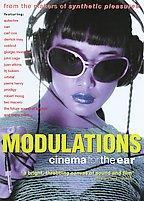
And lastly, last year I had a chance to watch a film called MODULATIONS (http://www.imdb.com/title/tt0139468/), which tries to introduce the root of electronic music. Full of interviews, impressive visual support and music for sure, if you ever have a chance to see it, you will be more satisfied.


So have a good weekend.


ART-IST EVENT: Yeno Ceno Music Program @ GalataPerform

Wednesday, November 29, 2006

La Jetee

photo-romans of Chris Marker La Jetee 1962

Friday, November 24, 2006

A graffiti artist - Blek Le Rat

Since it is the first contribution from someone apart from Ozge, i hope this bloggie to become more informative and up-to-date, so let's try to be much more intermediatic :)

From the time i set up my mind to do my project in a graffiti art form, I have been searching for well-known graffiti artists, I have come up with good results and wanted to share one of them with you.

Blek Le Rat is a graffiti artist who started to paint the streets in 1981. His first graffitis were rats, when he was asked why he chose rats, he replies


"I began to spray some small rats in the streets of Paris because rats are the only wild living animals in cities and only rats will survive when the human race will have disappeared and died out"

I'm gonna put some of his words on stencilry and his art, also an interview with Blek le rat. For more information just click this link http://bleklerat.free.fr


1983 the fisrt large figure in the life size I have make in the street. This is an old Irish man yelling against English soldiers in Belfast in the seventie's.The man is very brave because the soldiers are very nervous trying to shoot with their guns some guys from the IRA.The photo was incredible strong.I always been fascinated by the people at the risk of one's life do not hesitate to say what they think. I still use this image in this time and it is the image I have done the most in a lot of different countries.The man took many differebt aspect to the people sometimes he is an old man , sometimes people think he is Buster Keaton or Chaplin or a tramp or an anarchist.I like when my images take different aspect by the place where they are pasted


1991 Joseph Beuys in Paris and Koln in Germany


*sorry for the huuuge sizes of the images, i have just formatted my pc and I haven't got any image editting program.

For more works you can visit his site that is mentioned above.

Interview with Blek Le Rat :

In executing your paintings inside the frame of daily life, you somehow force you art onto by passers. Do you think its necessary to get outside the frame of conventional art to make people think ? Or did you choosed this media in order to reach peoples who usually access the places were art is exhibited ?
Yes, urban art is really a new way for an artist to express himself, as for example when I leave an image in the street I know that the next morning thousands of people will have seen this image. I don’t know if people think more but they are confronted to a form of artistic expression they are not used to. Its changing their way to approach « artistic » images they usually see in galleries or museums. In the case of urban art, it’s the image itself which goes straight to them, and I think that it’s also erasing a bit of the concept of the myth of sacred art! And this is a good thing.
How do you choose the right context for each of your pieces ?
I noticed during those years of work in the streets that the same image, for example the sheep, can take complete different dimensions, depending on the place I will put it. If I place it under the street sign of the Rue Saint Exupery, there will instantly be a Little Prince connotation, if I place it in front of a restaurant the connotation of the sheep can be linked with food for exemple. I mean the great strength of urban art is that it is not static, its changing all the time depending on the place where its made and of the image which is left on the wall. I’m keen on playing with my images and the place were I leave the image.
Also, people who see my image on the wall have the possibility to create their own story of the image they see. For exemple, the old guy shouting in the streets I was doing during the 80’, for some people, was Buster Keaton, for some others he was a homeless, and for others he was an old anarchist shouting against society. I like to leave the possibility to the spectators to use their own imagination while watching my images.
Do you consider to « embellish » the places where you execute your pieces ?
To embellish, I don’t know, anyway we can as much say that the city in general is awfully ugly or wonderfully beautiful. It all depends of your point of view to say so. I don’t have the feeling to embellish the city, I just have the feeling to make the city live, to belong to the city and to leave my trace there.
Can we see a political dimension in your art ?
Social dimension, yes, political I don’t think so as I don’t believe in politics anymore
Do you perceive graffiti as part of a counter culture ?
Yes, certainly at this time but I don’t know if this counterculture will stay one for long as the society love to absorb all counter-culture soon or late. We will be a counter-culture as long as we wont be in the museums, the day we will, we will belong to the culture with a big C.
Finally, which artists inspire you, in graphic arts but also in music or in art in general ?
Today I enjoy rap a lot, I used to like rock a lot. I listen to a lot of rap that my son Alex give me, while I work. I always loved English cinema, I also like a lot English painting of the XXth century, the American and English pop art, and the Greek and Roman antiquity

And finally I wanna share a quotation about graffiti that was appeared on the famous alternative culture magazine, Dazed and Confused magazine --->http://www.dazeddigital.com/

“When you do something for society,even illegal things, people will support you as long as they understand why you’re doing it. When you are negative or attack things , this support disappears.”

see you <3>


Thursday, November 23, 2006

PUBLIC LECTURE: Jérôme Game

Department of Western Languages & Literatures cordially invites you to a lecture by Dr. Jérôme Game of American University of Paris. This public lecture examines the recent developments, in the last twenty years, of poetic experimentation in French culture : How do contemporary writers negotiate the legacy of one hundred years of avant-gardist literary practice ? How to they introduce new procedures and media, such as sound and video recording, in their work ? What is the esthetic status of multi-media performances given today ? What is the role played by the voice and the body in poetic readings ? All these questions, and others, will be addressed from a theoretical and critical point of view so as to present a wide panorama of the profuse and very rich poetic production taking place in France today. Excerpts of various recordings and videos will be heard and shown. Jérôme Game will also give a reading of his work.
Friday, November 24, 16:00
Rektörlük Konferans Salonu

Class on Nov. 14: Artifacts & Buckminster Fuller


An artifact is an object that can produce a social change.


Buckminster Fuller was probably one of the first futurists and global thinkers. He is the one who coined the term "Spaceship Earth", "artist-scientist", "desing science"and "synergetics" and his work has inspired and paved the way for many who came after him.

Throughout his life, Fuller was concerned with the question "Does humanity have a chance to survive lastingly and successfully on planet Earth, and if so, how?"


Buckminster Fuller strove to inspire humanity to take a comprehensive view of the finite world we live in and the infinite possibilities for an ever-increasing standard of living within it. Deploring waste, he advocated a principle that he termed "ephemeralization" — which in essence Fuller coined to mean "doing more with less." Wealth can be increased by recycling resources into newer, higher value products whose more technically sophisticated design requires less material. In practice, it has often meant miniaturization, for example, as when table-model calculating machines were succeeded over time by smaller ones, until the calculator of today fits in one's hand. Fuller also introduced synergetics which explores holistic engineering structures in nature.

Fuller was one of the first to propagate a systematic worldview and explored principles of energy and material efficiency in the fields of architecture, engineering and design.
He dedicated himself to advancing the success and fulfillment of humanity and lived by a set of self disciplines; he was deeply concerned about sustainability and about human survival under the existing socio-economic system, yet was profoundly optimistic about humanity's prospects. Defining wealth in terms of knowledge, as the "technological ability to protect, nurture, support, and accommodate all growth needs of life", his analysis of the condition of "Spaceship Earth" led him to conclude that at a certain point in the 1970s humanity had crossed an unprecedented watershed.

What might otherwise sound like an article of faith in some spiritual or philosophical system had for Fuller become an objective fact — that the accumulation of relevant knowledge, combined with the quantities of key recyclable resources that had already been extracted from the earth, had reached a critical level, such that competition for necessities was no longer necessary. Cooperation had became the optimum survival strategy. "Selfishness", he declared, "is unnecessary and...unrationalizable...War is obsolete..."

By considering historical comparisons like the fact that even relatively poor people today are able to travel at speeds and with a degree of comfort which were unobtainable at any price in earlier times, and that illnesses that were fatal even to kings in the past can now be cured with affordable drugs, he concluded that everyone alive today can potentially live like a "billionaire." Hence he described the human race as "four billion billionaires."

Besides important comprehensiveness of thought and his philosophical concepts, Fuller's most lasting insights may be geometric. He claimed that the natural analytical geometry of the universe was based on arrays of tethedra. He developed this in several ways, from the close-packing of spheres and the number of compressive or tensile members required to stabilize an object in space. Some deep confirming results were that the strongest possible homogeneous truss is cyclically tetrahedral.

for more information:

Buckminster Fuller Institution
Buckminster Fuller on PBS

Sunday, November 12, 2006

Art-Ist Place: GalataPerform


I want to introduce this intermediatic place, in a second floor apartment, in the historical district of Galata. It has been the production space and main stage of Ve Diğer Şeyler Theatre Company, founded by the playwright and theatre director Yeşim Özsoy Gülan, and has been open to artists and audiences of different disiplines.

The program has contemporary theatre, performance art, dance, video, internet art and new music, as its main ax. It provides an alternative venue for artists where audiences meet marginal and experimental art productions, with a mission is to create a platform for the production of free, authentic, contemporary thoughts and actions, debating prejudices to activate a peaceful project of the future.

The space of GalataPerform, composed of an informal cafe and a performing studio, is not a white cube gallery, neither a hi-tec concert hall. In this respect, it is a space of intensified living or possibilities to spring out among the art work, the venue and the participant. In this space, the performances and the presented images are open to the incidental impact of the venue and of the visitor; in this chaotic order, the art works can't impose themselves, as they can't turn into object-products. The work of art is an energy which serves to create signs, forms, acts or objects, sometimes, in daily ambiences. Consequently, the borders between art and daily life, and the borders between different disciplines disappear. In GalataPerform, the process that the artists and participants live and create all together, becomes a collective work; an organism that keeps on evolving. The elements that form the organism focused on process and not on object, are individual and common thoughts, relations and acts that arise through the presentation or absence of the artistic processes, objects and acts. In this space, nothing remains of the fetish conventional art forms. Artistic processes beyond time and category are perceived.

(taken from their web-site)


There are two events taking place until the end of November.

16 November, Thursday 7.00 pm- Theatre: In the context of "New Text New Theatre" Project there is a talk with Sibel Arslan Yeşilay who is a faculty member of Haliç University Conservatory Theatre Department.
For more information on the Project: www.newtextnewtheatre.org

25 November, Saturday 9.30 pm- Electronic Music: Islak Köpek, free emprovization of five musicians of five different approach.
fee: 10YTL; student: 7.5 YTL

Wednesday, November 08, 2006

Class on Nov. 7: Intermedia Painting


Stan Brakhage (1933 - 2003) is regarded as one of the most important American filmmakers of the 20th century.

Brakhage was born as Robert Sanders in an orphanage in Kansas City, Missouri. Three weeks after his birth, he was adopted by Ludwig and Clara Brakhage, and he was given the name James Stanley Brakhage.

As a child, he appeared on radio as a boy soprano before going to high school and then dropping out of Dartmouth College after several months to make films. He was influenced by the writings of Sergei Eisenstein and the films of Jean Cocteau as well as the Italian neorealism movement.

In 1953, Brakhage moved to San Francisco where he associated with poets such as Robert Duncan and Kenneth Rexroth. In late 1954, he moved to New York City where he associated with a number of contemporary artists, such as abstract expressionist painters and beat generation poets, among them Maya Deren, Marie Menken, Joseph Cornell and John Cage.

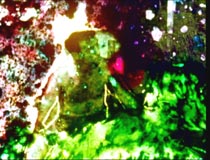
In a time, 1950s, when film id rooted in Hollywood cinema and large productions Stanley Brakhage made his films by himself and one camera. Brakhage's films are usually silent and lack a traditional story, being more analogous to visual poetry than to prose story-telling. He often referred to them as "visual music." His films range in length from just a few seconds to several hours, but most last between two or three minutes and one hour. For him the film itself was also a material. Most of his work was done in 8 mm or 16 mm film, and he frequently hand-painted the film or scratched the image directly into the film emulsion, baked the film in the owen and sometimes used collage techniques. For Monthlight(1963), for example, he stuck moth wings, twigs, and leaves onto tape and made prints from it. He called his style as "closed eye vision" in which painting and cinema work in a totally different way.

Brakhage's work covers a variety of subjects and techniques. Window Water Baby Moving (1959) is a record of the birth of his first child, while 23rd Psalm Branch (1966-67) is a meditation on war that intercuts footage of Colorado, where he lived, with shots of World War II. Dog Star Man (1961-64), perhaps his most famous work, features a man climbing a mountain, shots of stellar objects and more footage of his wife giving birth. It is usually read as addressing the unity of creation. Works from his later periods include the four-part "Faust Series" (1987-89), the four-part "Visions in Meditation" (1989-90), "Passage Through: A Ritual" (1991), and "The Vancouver Island Quartet" (1991-2002). He also completed several more collaborations with musicians, including two more works with music by James Tenney, "Christ Mass Sex Dance" (1991), and "Ellipses #5" (1998). For Marilyn, which was made in 1992 was about his wife and her embodying his concept of God.

Brakhage wrote a number of books, including Metaphors on Vision (1963) and the posthumously published "Telling Time: Essays of a Visionary Filmmaker" (2003). He often gave lectures at universities, museums, galleries, film festivals and so on.
It is believed that the coal-tar dyes he used to paint his films contributed to the cancer.

His work has had some small impact on contemporary art, music videos, mainstream cinema. The credits of the film Seven, with their scratched emulsion, rapid cutaways and bursts of light are very much in Brakhage's style.

Stanley Brakhage: a short information by Fred Camper


Barry McGee
A lauded and much-respected cult figure in a bi-coastal subculture that comprises skaters, graffiti artists, and West Coast surfers, Barry McGee was born in 1966 in California, where he continues to live and work. In 1991 he receiv ed a BFA in painting and printmaking from the San Francisco Art Institute. His drawings, paintings, and mixed-media installations take their inspiration from contemporary urban culture, incorporating elements such as empty liquor bottles and spray-paint cans, tagged signs, wrenches, and scrap wood or metal. McGee is also a graffiti artist, working on the streets of America’s cities since the 1980s, where he is known by the tag name “Twist.” He views graffiti as a vital method of communication, one that keeps him in touch with a larger, more diverse audience than can be reached through the traditional spaces of a gallery or museum. His trademark icon, a caricatured male figure with sagging eyes and a bemused expression, recalls the homeless people and transients who call the streets their home. “Compelling art to me is a name carved into a tree,” says McGee. His work has been shown at the Walker Art Center in Minneapolis, the San Francisco Museum of Modern Art, the UCLA/Armand Hammer Museum in Los Angeles, and on streets and trains all over the United States. He and his daughter, Asha, live in San Francisco.


Matthew Ritchie was born in London, England in 1964, and lives and works in New York. He received a BFA from Camberwell School of Art, London, and attended Boston University. His artistic mission has been no less ambitious than an attempt to represent the entire universe and the structures of knowledge and belief that we use to understand and visualize it. Ritchie’s encyclopedic project (continually expanding and evolving like the universe itself) stems from his imagination, and is catalogued in a conceptual chart replete with allusions drawn from Judaeo-Christian religion, occult pract
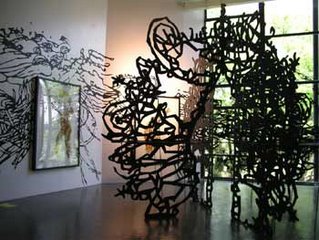
ices, Gnostic traditions, and scientific elements and principles. Ritchie’s paintings, installations, and narrative threads delineate the universe’s formation as well as the attempts and limits of human consciousness to comprehend its vastness. Ritchie’s work deals explicitly with the idea of information being ‘on the surface’, and information is also the subject of his work. Although often described as a painter, Ritchie creates works on paper, prints, light-box drawings, floor-to-wall installations, freestanding sculpture, web sites, and short stories which tie his sprawling works together into a narrative structure. Drawing is central to his work, he doesn't think that there are boundries between drawing, sculpture and computer games, though. He perceives it as information. He scans his drawings into the computer so that images can be blown up, taken apart, made smaller or three-dimensional, re-shaped, transformed into digital games, or given to someone else to execute. One ongoing work that Ritchie calls an endless drawing contains everything he has drawn before. Ritchie’s work has been shown in one-person exhibitions at the Dallas Museum of Art; Contemporary Arts Museum, Houston; MASS MoCA; SFMoMA; and the Museum of Contemporary Art, Miami, among others. His work was also exhibited at the Whitney Biennial (1997), Sydney Biennale (2002), and São Paulo Bienale (2004).


An interview by Owen Drolet

Monday, November 06, 2006

Class on Oct 31: Traditional art vs. Contemporary Art

Does originality goes back to the origin? Three artists we have studied last week (a miniature painter, a naturalist painter and an artist well known for her paper-cuts), all have in common expertise in a traditional form of art and technical ability required. However, the content of their work differs from the traditional themes.


Shanzia Sikander


She was born in 1969 in Lahore, Pakistan. Educated as an undergraduate at the National College of Arts in Lahore, she received her MFA in 1995 from the Rhode Island School of Design. Sikander specializes in Indian and Persian miniature painting, a traditional style that is disciplined. While becoming an expert in this technique-driven, often impersonal art form, she imbued it with a personal context and history, blending the Eastern focus on precision and methodology with a Western emphasis on creative, subjective expression. Sometimes working several years for one single piece, arranging everything to be near and precise, self expression comes later, she says. As opposed to her miniatures, her installation pieces are huge and consumes much less time. Reared as a Muslim, Sikander is also interested in exploring both sides of the Hindu and Muslim “border,” often combining imagery from both—such as the Muslim veil and the Hindu multi-armed goddess—in a single painting. Sikander has received many awards and honors for her work, including the honorary artist award from the Pakistan Ministry of Culture and National Council of the Arts. Sikander resides in New York and Texas.


Walton Ford


He was born in 1960 in Larchmont, New York. Ford graduated from the Rhode Island School of Design with the intention of becoming a filmmaker, but later adapted his talents as a storyteller to his unique style of large-scale watercolor. Blending depictions of natural history with political commentary, Ford’s meticulous paintings satirize the history of colonialism and the continuing impact of slavery and other forms of political oppression on today’s social and environmental landscape. Each painting is as much a tutorial in flora and fauna as it is as a scathing indictment of the wrongs committed by nineteenth-century industrialists or, locating the work in the present, contemporary American consumer society. An enthusiast of the watercolors of John James Audubon, the most famous naturalist painter from the 19th century, Ford celebrates themyth surrounding the renowned naturalist-painter while simultaneously repositioning him as an infamous anti-hero who, in reality, killed more animals than he ever painted. He is playing that role in a conscious way: he reinevents the ruined tradition.

Each of Ford’s animal portraits doubles as a complex, symbolic system, which the artist layers with clues, jokes, and erudite lessons in colonial literature and folktales. Walton Ford is the recipient of several national awards and honors including a fellowship from the John Simon Guggenheim Memorial Foundation and the National Endowment for the Arts. Ford’s work has been featured at Bowdoin College Museum of Art, the Southeastern Center for Contemporary Art, the Whitney Museum of American Art at Champion, and the Forum for Contemporary Art in St. Louis. After living in New York City for more than a decade, Walton Ford relocated his studio to Great Barrington, Massachusetts. Ford and his family reside in upstate New York.

For his works of art, please click here!


Kara Walker


She was born in Stockton, California in 1969. She received a BFA from the Atlanta College of Art in 1991 and an MFA from the Rhode Island School of Design in 1994. The artist is best known for exploring the raw intersection of race, gender, and sexuality through her iconic, silhouetted figures. Walker unleashes the traditionally proper Victorian medium of the silhouette directly onto the walls of the gallery, creating a theatrical space in which her unruly cut-paper characters fornicate and inflict violence on one another. Her technique is extremely cinematic but rooted in drawing. In recent works like "Darkytown Rebellion" (2000), the artist uses overhead projectors to throw colored light onto the ceiling, walls, and floor of the exhibition space. When the viewer walks into the installation, his or her body casts a shadow onto the walls where it mingles with Walker’s black-paper figures and landscapes: she projects fiction into those facts. With one foot in the historical realism of slavery and the other in the fantastical space of the romance novel, Walker’s nightmarish fictions simultaneously seduce and implicate the audience. Thus fact and fiction, black and white go together in her work. Walker’s work has been exhibited at the Museum of Modern Art, the San Francisco Museum of Modern Art, the Solomon R. Guggenheim Museum, and the Whitney Museum of American Art. A 1997 recipient of the John D. and Catherine T. MacArthur Foundation Achievement Award, Walker was the United States representative to the 2002 São Paolo Bienal in Brazil. Walker currently lives in New York where she is on the faculty of the MFA program at Columbia University.

for the article on Kara Walker, Cut it Out, by Hilarie M. Sheets please click here!

Wednesday, October 25, 2006

once an intermediatic, always an intermediatic!

First intermedia event. Video by Ali İhsan Uğurlu.

Saturday, October 21, 2006

STOMP!


I want to announce a group of very successful intermediatics:Stomp, a unique combination of percussion, movement and visual comedy. Below is the information gathered from their web page, www.stomponline.com There are also downloadable video and audio clips. Enjoy!


What does the word STOMP make you think of?

Music, Dance, Theatre, Choreography or Performance Art? All of the above! Or is it none of the above. Well, both are sort of right...In a way. Confused? read on...

STOMP is a movement, of bodies, objects, sounds - even abstract ideas. But what makes it so appealing is that the cast uses everyday objects, but in non-traditional ways.

There's no speech, no dialogue, not even a plot.

So why go see STOMP? Well, have you ever composed a symphony using only matchbooks as instruments? Or created a dance routine based around sweeping? You may have done this a little, but get a group of rhythmically gifted, extremely coordinated bodies with definitive personalities, and you have the makings for STOMP.

STOMP started stomping on the streets of Brighton, England. Luke Cresswell and Steve McNicholas the creators of STOMP were a group of street performers commonly know as "buskers" trying to grab people's attention.

And attention is what they received

Busking is an old custom in the UK, dating back to booth theatres erected at village fairs in the Middle Ages. Luke and Steve updated this historical custom and created a modern symbiotic marriage between movement and music.

You're mistaken if you look for a hidden message in STOMP. There are no political connotations, no pretentious techniques, and no dialogue to misconstrue. Instead, you're bombarded by noises that you usually try to block out. STOMP takes the everyday sounds of pipes and brooms, lighters and garbage pail lids, and creates the extraordinary.

So how do you describe STOMP? If you ask one of the creators, Luke Cresswell, he would simply say, "at the end of the day, STOMP is what it is."

Class on Oct. 17: experimental works in video

Jan Svankmayer

Czechoslovak animator extraordinaire, Jan has been making intensely bizarre films since the mid-'60s. Most of his work is a mix between 3-D stop-motion animation, puppets and live-action, but it can involve any mix of the above. His stories are eerie, delightful, dreamlike and surreal. His actors include real people, machines, socks, clay figures, antique dolls, pencil sharpeners, and skeletons or stuffed corpses of animals, among other things. His sets are usually decaying Czech buildings or landscapes, decorated with waste of the industrial age: rotting furniture, rusty nails, sawdust, oily screws, and the like.

for A Jan Svankmayer filmography/videography page, please click here!

Svankmayer definetely influenced many others like Tim Burton. Brothers Quay took his ideas much further and even dedicated "The Cabinet of Jan Svankmayer" to him.


Brothers Quay

Identical twins born in Norristown, Pennsylvania, Stephen and Timothy Quay studied at the Philadelphia College of Art until they transferred to London's Royal College of Art, where they started producing animated shorts in the early 70s.

The Quay's films are influenced by those of Jan Svankmajer: a harsh, grimy world where decay is the primary decor, but they add a sharp neo-gothic edge to and maintain a thoroughly personal hand-on approach to their film-making, where Svankmajer designs his films and lets others animate them. Not only their materails and political ideas are striking, but also their editing techniques: the rythym created by the movement of the camera. The Quay's puppets are also of the same ilk (creepy antiquated-looking toys, bones, meat, etc.), but have a more polished look. The Quay's plots are minimal and dark, their films surreal, stream-of-consciousness nightmares with a definite edge of humor.

Some of the Quay's actual sets and puppets are on permanent exhibition at The Museum of the Moving Image in London.

Since they don't want their images on web, we cannot include any. Yet, for the filmography you can click here.


Bill Viola
Born in January 25, 1951, he is today known for his work in video art. His exhibition profile, which includes the Guggenheim Berlin, Guggenheim New York, Getty Los Angeles, California, and the Metropolitan Museum of Art, New York marks him as a major artist, at least by standards of public fame and repute. His work has also received extensive critical praise from both within the video art community and in the culture at large, which is unusual for an artist whose work often challenges the narrative conventions of the television screen.

His early work established his fascination with issues that continue to inform his work today. In particular, Viola's obession with capturing the essence of emotion through recording of its extreme display began at least as early as his 1976 work, "The Space Between the Teeth", a video of himself screaming, and continues to this day with such works as the 45-second "Silent Mountain" (2001), which shows two actors in states of anguish.

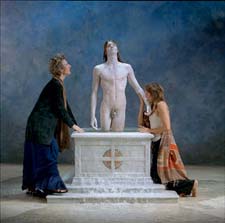
If Viola's depictions of emotional states with no objective correlative -- emotional states for which the viewer has no external object or event to understand them by -- are one striking feature of many of his works, another, which has come to the forefront, is his reference to medieval and classical depictions of emotion. Most immediately, his subdued "Catherine's Room" 2001, has many scene by scene parallels with Andrea di Bartolo's 1393 "St. Catherine of Siena Praying".

While many video artists have been quick to adopt new technologies to their medium, Viola relies little, if at all, on computer editing and modification of his video. Perhaps the most technically challenging part of his work -- and that which has benefitted most from the advances since his earliest pieces -- is his use of extreme slow motion. "The Quintet Series" 2000 is one such piece (actually a set of four separate videos), that shows the unfolding expressions of the five actors in such slow motion that the expressions become almost unrecognizable. The series is a challenging one for the viewer, because the concentration required to follow the facial expressions over time must last for minutes or more. In general, the distortion of time, along with the lack of sound or voice over, form the most immediately ""new"" aspects of Viola's work for the first-time viewer.

One remarkable piece by Viola is his "Observance" 2002, which may be taken partly as a response to the September 11, 2001 Terrorist Attacks. "Observance" places the camera at eye level facing the head of a line of people of a wide variety of ages. As "Observance" unfolds, the line slowly advances, with each person pausing at the front of the line in a state of intense -- though quiet -- grief, before ceding their place to the next person in line.

In 2004, Viola embarked on "The Tristan Project". At the invitation of opera director Peter Sellars, he created video sequences to be shown as a backdrop to the action on stage during the performance (directed by Sellars) of Wagner's opera Tristan und Isolde. Using his trademark extreme slow motion, Viola's pieces used actors to portray the metaphorical story behind Wagner's story, seeing for example the first act as an extended ritual of purification in which the characters disrobe and wash themselves before finally plunging headlong into water together (in Wagner's story, the two characters maintain the facade of being indifferent to each other (necessary because Isolde is betrothed to Tristan's uncle) before, mistakenly believing they are going to die anyway, they reveal their true feelings). Viola trademarks such as fire and water are much in evidence here. The piece was first performed in Los Angeles at Disney Hall on 3 separate evenings in 2004, one act at a time, then given complete performances at the Bastille Opera in Paris in April and November 2005. The video pieces were later shown in London without Wagner's music in June to September 2006, at the Haunch of Venison Gallery and St Olave's College.

Viola's work has received many critical accolades. Marjorie Perloff, best known for her poetry criticism and her promotion of avant-garde writers and styles, singles him out for praise. Perloff, who has written at length about the necessity of poetic works responding to and taking advantage of contemporary computer technologies, has written of Viola as an example of how new technology -- in his case, the video camera -- can create entirely new aesthetic criteria and possibilities that did not exist in previous incarnations of the genre -- in this case, theater.


For Bill Viola's official web site, please click here!

Tuesday, October 10, 2006

Conceptual Art, Marcel Duchamp and Sol Lewitt

Conceptual art, is art in which the concept(s) or idea(s) involved in the work take precedence over traditional aesthetic and material concerns. All of the planning and decisions are made beforehand and the execusion is a perfunctory affair. In some cases, Conceptual art may not entail any art object per se, but instead manifest solely as documentary evidence for an "art idea". In other, less extreme cases, Conceptual art may involve the construction of images and objects in a manner that frees the artist from their traditional role as a maker of aesthetic decisions.

Many of the works of the artist Sol Lewitt may be constructed by anyone simply by following a set of written instructions. This method was fundamental to Lewitt's definition of Conceptual art, the first to appear in print "Paragraphs on Conceptual Art", Art Forum, 1967.

The movement began in the early 20th century, but was based on the European Dada movement, its father Marcel Duchamp, and the writings of philosopher Ludwig Wittgenstein.


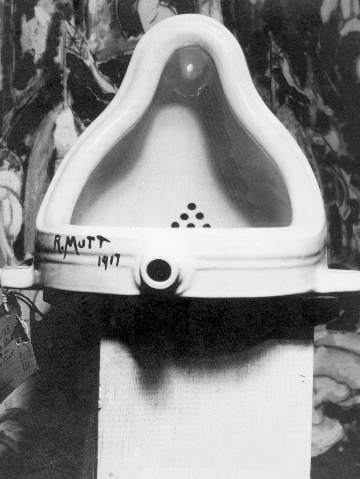
The French artist Marcel Duchamp paved the way for the conceptualists, providing them with examples of prototypically conceptual works (the readymades, for instance) that defied conventional categorisation. The most famous of Duchamp's readymades was Fountain (1917), a standard urinal basin signed by the artist with the pseudonym "R.Mutt", and submitted for inclusion in the annual, un-juried exhibition of the Society of Independent Artists in New York--it was rejected. In traditional terms, a commonplace object such as a urinal cannot be said to be art because it is not made by an artist or with any intention of being art, it is not unique, and it possesses few of the expected visual properties of the traditional, hand-crafted art object. Duchamp's relevance and theoretical importance for future "conceptualists" was later acknowledged by US artist Joseph Kosuth in his 1969 essay, "Art after Philosophy," when he wrote: "All art (after Duchamp) is conceptual (in nature) because art only exists conceptually."
(For more information: Making sense of Marcel Duchamp and Marcel Duchamp World Community )

Conceptual art was the forerunner for installation, digital, and performance art, more generally art that can be experienced.


Sol LeWitt (born 1928 in Hartford, Connecticut) is an artist linked to various movements including conceptual art and minimalism. His mediums are predominantly painting, drawing, and structures (a term he prefers in opposition to sculpture).

LeWitt's most characteristic sculpture works are based on connected open cubes and have titles like "Modular Wall Structure" and "Double Modular Cube." Because he works with modules and systems, and his early wall drawings are based on grids, he is sometimes described as a Minimal artist, but his work, especially his recent work, is usually colorful and often quite complex. It is also optimistic and beautiful.

In his writings "Sentences on Conceptual Art" and "Paragraphs on Conceptual Art" he puts down the characteristics of conceptual art. He distinguishes the new art form from the formal art by claiming that the former is mystical while the latter is rational. He says that irrational thoughts should be followed absolutely and logically. For him banal ideas cannot be rescued by beautiful execution, on the contrary his understanding of the process is machine-like. Also, he makes a distinction between conceptional and perceptional art. Perceptional art is for the sensation of the eye, like optical, kinetic, light and color art.

The rules Lewitt manifested in his writings contradict with the works of Turrell and Orozco. Turrell uses light predominantly, and the way his works actually seen is important, on the other hand, his ideas behind his body of work do matter a lot as well. Should he be considered as a perceptional or conceptional artist?
Orozco, on the other hand found the art making process very important, as opposed to Lewitt.

Can we ever reach a consensus about what distinguishes conceptual art; or what is art and what is not at the first place? The fountain was a joke for Duchamp, but was taken very seriously by critics. Can we produce art by solely placing objects in the museum, by altering their message? How much does the final look of the work matter; and how about the concept of it?
What should be our criteria?

The Class on Oct.10- screenings: James Turrell, Gabriel Orozco

James Turrell


Turrell’s work involves explorations in light and space that speak to viewers without words, impacting the eye, body, and mind with the force of a spiritual awakening. “I want to create an atmosphere that can be consciously plumbed with seeing,” says the artist, “like the wordless thought that comes from looking in a fire.” Informed by his studies in perceptual psychology and optical illusions, Turrell’s work allows us to see ourselves “seeing.” In a sense his main media is the light itself and involve the active participation of the viewers.
Roden Crater, which is near the Grand Canyon in Arizona, is an extinct volcano the artist has been transforming into a celestial observatory for the past thirty years. Its curved shape provides him with the opportunity of losing the horizontal sense.
His fascination with the phenomena of light is ultimately connected to a very personal, inward search for mankind’s place in the universe.

For an interview with Turrell (made in 1996) please click here!
For more information, biography and works please click here!


Gabriel Orozco


An avid traveler, Gabriel Orozco uses the urban landscape and the everyday objects found within it to twist conventional notions of reality and engage the imagination of the viewer. He is interested in complex geometry and mapping, it is expressed in his works "Oval Billard Table".
He defines camera as a way of experience, giving way to intimate relationship with the world. He even approaches sculpture in his work "La D.S." Car sculpture, in such a way that he distorts the perspective.
Matching his passion for political engagement with the poetry of chance encounters, Orozco’s photographs, sculptures, and installations propose a distinctive model for the ways in which artists can affect the world with their work.

For more information, biography and works please click here!


Sunday, October 08, 2006

ART-IST EVENTS

We all laughed at Cristopher Columbus
Platfrom Garanti Contemporary Art Center
Sept.14 - Oct.21


Roderick Buchanan, Jeremiah Day, Omer Fast, Runo Lagomarsino, Deimantas Narkevicius, Amalia Pica, Florian Wüst

Much artistic and curatorial practice today aims at exploring the truthfulness of historical representation, or the problematic dialectic between collective memory and factual source. Of late, there has been a great deal of attention on artistic practices that focus on reconstructions of historical events - from reenactments to documentary videos, the aim is often to question, investigate or reconsider social attitudes of interpretation. Opposed to these tendencies the exhibition We all laughed at Christopher Columbus deals primarily with subjective, artistic interpretations of specific historical events.

http://www.platform.garanti.com.tr/plat_pop.html


Right Place, Right Time

İstanbul Modern
Sept.7 - Nov.12

Gökşin Sipahioğlu’s photograph exhibition entitled "Right Place, Right Time" opened on 7th September in İstanbul Modern. Realized with the contributions of Fortis and curated by Engin Özendes, the exhibition will host 119 photographs of Gökşin Sipahioğlu, a prominent name of Turkish and global photojournalism for more than half a century.

http://www.istanbulmodern.org/en/f_index.html


IFSAK 1st International Istanbul Biennial of Photography
Sept.15 - Oct 31

The event is aiming to highlight the value of photographic art with its approach to open up new horizons and to organize a photography feast lasting for 6 weeks for national and international visitors.

IFSAK 1st International Istanbul Biennial of Photography, will focus on the theme “City: Chaos and Charm” while including other brilliant works not so closely related with the theme.

http://www.ifsak.org/bienal/eng/index.html

Wednesday, October 04, 2006

The Class on Oct.3: Andy Goldsworthy


Andy Goldsworthy (born 1956, in Cheshire) is an English artist and photographer living in Scotland who produces site specific sculpture and land art situated in natural settings. His art involves the use of natural and found objects to create temporary sculptural pieces which both appear naturalistic and create stark contrasts with their surroundings.

His media often include twigs, thorns, stone, mud, snow, icicles, brightly coloured flowers and leaves. He often uses only his bare hands, teeth, and found tools to prepare and arrange the materials, although more recent works like Moonlit Path and Chalk Stones (Petworth, West Sussex - 2002) have also used heavy machinery.

Goldsworthy is a subject of a 2001 documentary feature film Rivers and Tides directed by Thomas Riedelsheimer. (ASIN: B0002JL9N6). He received an honorary degree from the University of Bradford in 1993, and was appointed OBE in 2000. He is the son of F. Allin Goldsworthy, 1929-2001, professor of applied mathematics at the University of Leeds.
(wikipedia)


He makes transient sculptures as opposed to the permenance of more conventional art forms. "I am still with it" says he talking about one of his works, and adds "but I can't see it... It is given to the sea as a gift. Sea made more out of it." He is by no means the final authority of his work. Nature is unpredictable. The material he is given, the way his work is destroyed... all is determined by the nature itself.
Therefore, he makes use of photography to document "the essense of his work".
How should we call him: a sculptor, an environmental sculptor’ or a ‘sculptor/photographer’? He forces us to reconsider what art is primarily, and how do we (or should we at all) locate the borders between different branches of art. Lastly, as soon or later most of his (final)work disappears, does the "idea" of his work matter more than its physical identity?

for more information about Andy Goldsworthy:
Artcyclopedia, Andy Goldsworthy
What is Art? What is an Artist?
Andy Goldsworhty: Tbe Beauty of Creation

Monday, October 02, 2006

The Class on Sept. 26: Krzysztof Wodiczko, Ann Hamilton, Cai Guo-Qiang


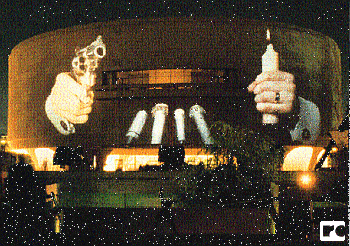
Wodiczko is internationally renowned for his large-scale slide and video projections on architectural facades and monuments. Since the late eighties, he has developed a series of nomadic instruments for both homeless and immigrant operators that function as implements for survival, communication, empowerment, and healing. He creates art by projecting images upon the monumental architecture found in large cities. The image of a homeless person materializes on a Boston war monument. The message of his medium adds to/edits that of the monument.
The artist spent half his life behind "the Iron Curtain" and the other half in Canada and the United States, so he has a well developed critique of power and it's abuses. Wodiczko's art is profoundly democratic. It forces the viewer to reexamine the function of architecture and to reconsider the political nature of the steel and concrete caverns of commerce that make up large cities.

For more information please click here!


Hamilton
was born in 1956 in Lima, Ohio. She trained in textile design at the University of Kansas, and later received an MFA from Yale University. While her degree is in sculpture, textiles and fabric have continued to be an important part of her work, which includes installations, photographs, videos, performances, and objects. She also questions the space around the art piece and ends up using the whole space. She is an important name of installation art.

For more information please click here!


Cai Guo-Qiang was born in 1957 in Quanzhou City, Fujian Province, China, and lives and works in New York. He studied stage design at the Shanghai Drama Institute from 1981 to 1985 and attended the Institute for Contemporary Art: The National and International Studio Program at P.S. 1, New York. His work is both scholarly and politically charged.
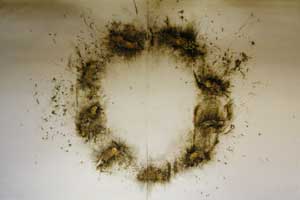
He combines installation and traditional forms of Chinese art. His most prominent element od his body of work is called "gun powder drawings". He draws a comparison between drawing and love making; thus puts the emphasis on performance rather than the final image.
He says: "Art is not about what it is saying."

For more information please click here!

RELATED BOOKS

-all available in the Boğaziçi Library-

Installation Art in the New Millennium - Jonathan Crary
Body Art and Performance - Linda Wintraub, et al.
L'Ombra Della Regione: Shadow of Reason - Exploring the Sipiritual in European Identity in the 20th Century - Danilo Escher
Vitamin P - Barry Schwabsky
Out of Actions: Between Performance and the Object 1949-1979 - Paul Schimmel
Assemblage, Environments & Happenings
Performance: Live Art Since 1960 - Rosalee Goldberg
Overlay: Contemporary Art and the Art of Prehistory - Lucy R. Lippard
Virtual Art: From Illusion to Immersion - Oliver Grau
Art in America Magazine

ASSIGNMENT

The assignment consists of a paper and/or a media-based project. Projects done for this class will be determined entirely by each student, and will grow out of a process of research and exploration guided by the instructor. Because conceptual art is based on the concept that art may exist solely as an idea, this process of research and its documentation may in fact become more important than the final result of the project. By being involved all the way through this process the instructor will be able to grade the project all the way through its development.

Everyone in this class will write a paper that discusses one of the readings in relation to one or more of the artists covered in this course. Students who choose to do only the paper are required to write a minimum of eight pages that investigates the chosen topic in detail. Students who choose to create a media-based project will write a shorter version of the paper one to two pages in length.

The media-based project needs to be approved by the instructor, and should use media that the student has previous knowledge about and access to all necessary equipment.

INTRODUCTION: The Intermediatics

This community is composed of Boğaziçi University (İstanbul- Turkey) students and graduates, who have taken the Intermedia course, led by their teacher Jeffrey Baykal Rollins. He is a photographer, painter and installation artist. However, neither his work, nor his teaching mentality distinguishes betweem different disciplines of art. Since 2005 he has been giving intermedia course.

Intermedia
is an interdisciplinary course which brings together students working with a variety of media in a shared conceptual framework. This theory-based course offers students the opportunity to create conceptual art projects that grow out of research in their chosen areas of interest. Furthermore, Intermedia provides an area for students to work across disciplines, whether it be a filmmaker using installation art, a poet using performance, or a physics student using video and digital media. Through lectures, screenings, guest artists, and readings, students is exposed to a wide range of working methods that will help them to bring a work of art from idea to completion.

Each term the course has a happening in the campus where the students can show their videos, perform their pieces, have their installations exhibited. In every two years we are planing to arrange an Intermedia Biennial which would expand out of our campus.