Showing posts with label performance. Show all posts

Tuesday, July 10, 2007

Maya Deren and Experimental Work in Video

"And what more could I possibly ask as an artist than that your most precious visions, however rare, assume sometimes the forms of my images.


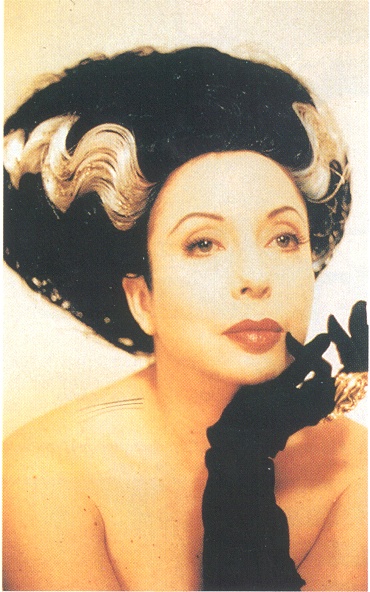
Deren was a dancer, choreographer, poet, writer and photographer. In the cinema she was a director, writer, cinematographer, editor, performer, entrepreneur and pioneer in experimental filmmaking in the United States.


When she was born in Kiev in 1917 and was named Eleanora. In 1922 the Derenkowsky family fled to New York due to the threat of anti-semitism in the Ukraine. They contracted and Anglicized their name to Deren.


As a young woman Eleanora Deren studied journalism and political science and became active in student politics at Syracuse University. Deren transferred to New York University where she was awarded her undergraduate degree in 1936. At Smith College she completed a Masters Degree in English Literature and symbolist poetry in 1939. After college Deren began working as an assistant to the famous dancer and choreographer, Katherine Dunham. Deren found inspiration and nomadic adventure with the innovative Katherine Dunham Dance Company, touring and performing across the US. It was in Los Angeles in 1941 that Deren met Alexander Hammid, a Czechoslovakian filmmaker working in Hollywood. In collaboration with Hammid, Deren produced her first and most remarkable experimental film Meshes of the Afternoon (1943).


In 1943 she changed her name to Maya and shifted her focus from dance to film.

Rhythm is a defining element of all of Deren's films, it arises from the play of repetition and variation which is integral to her experiments in narrative. Meshes deploys an innovative style of cutting on action where the protagonist steps over such disparate terrains as the beach, soil, grass and concrete. The rhythmic drumbeat and the repeated movement highlight her deliberate progress across these discontinuous spaces. As the central, consistent element, Its soundtrack enables Deren's temporal and spatial experimentation."

from the article by Wendy Haslem:
Maya Deren: The High Priestess of Experimental Cinema
http://www.sensesofcinema.com/contents/directors/02/deren.html

for more information on the woman "who makes the world dance":
http://www.cosmicbaseball.com/deren9.html#text

"Some Metaphors For The Creative Process" by Maya Deren
http://www.wam.umd.edu/%7Emolouns/amst450/village/deren.html


Friday, April 27, 2007

Some Pictures From Babel

ayca kubat presents:

Jeffrey-Şems-Güneş


Ayça "babel is on"

Özge "içine kapanık"

Wednesday, March 07, 2007

Post-Babel

Dear Babyloneans,

For the first time we -as the intermedia community- made an event out of the South Campus, thanks to everyone who participated as artists, supporters, visiters and translators. The major criticism was the lack of rehearsals, which I cannot deny. However, many people, including our program director, said the whole night was great.

As soon as we get rid of our exhaustion, we will start planning the next happening, which will be THE INTERMEDIA BIENNIAL. Where would you prefer it to be? Guggenheim?

Thursday, February 22, 2007

Babel!


2nd meeting for Babel: 01.03.2007
Time & Place: TBA

Monday, February 05, 2007

Meeting for Babel

It is time to start "babbling" about "Babel". There will be a meeting
this Wednesday, February 7, from 17:30 to 19:00 at GalataPerfrom to
begin our collaboration, and you are strongly encouraged to attend.
GalataPerform is located at:

Büyük Hendek Caddesi No:37/1 Galata Kuledibi, Beyoðlu
Tel: 0090 212 2439991, 0090 535 880 3339
info@galataperform.com

Because it can be hard to find the first time, we will meet directly
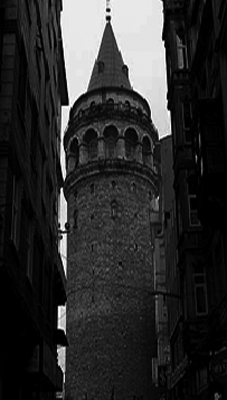
in front of the Galata Tower at 17:25 and then walk to GalataPerform.

See you then,

Jeffrey

Thursday, January 18, 2007

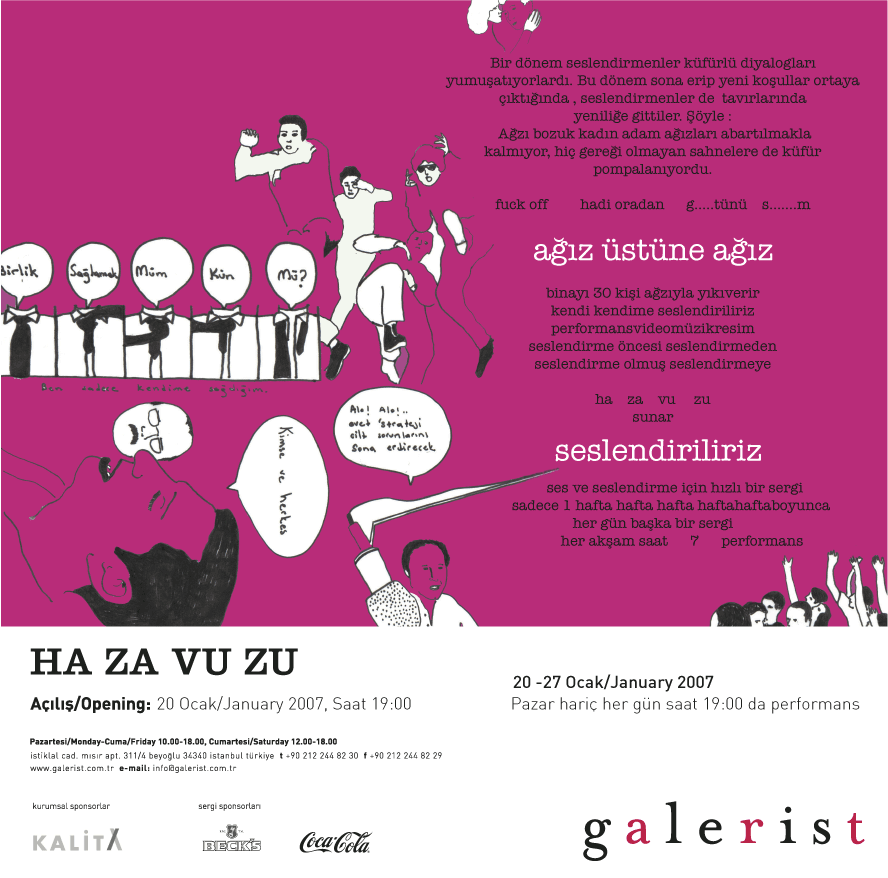
ART-IST EVENT: HAZAVUZU @ GALERIST

BABEL @ GalataPerform, March 7, 2007


Curated by Jeffrey Baykal Rollins, “Babel” is an evening of student performance works exploring issues of art and language, with an emphasis on the spoken-word. Over the course of the event individual works will evolve into a collaboration amongst all the participants, bridging differences in culture, language, media and a variety of art disciplines.

Performance art is art in which the actions of an individual or a group at a particular place and in a particular time constitute the work. It can happen anywhere, at any time, or for any length of time. Performance art can be any situation that involves four basic elements: time, space, the performer's body and a relationship between performer and audience. It is opposed to painting or sculpture, for example, where an object constitutes the work. Of course the lines are often blurred.

Although performance art could be said to include relatively mainstream activities such as theater, dance, music, and circus-related things like fire breathing, juggling, and gymnastics, these are normally instead known as the performing arts. Performance art is a term usually reserved to refer to a kind of usually avant-garde or conceptual art which grew out of the visual arts.

Spoken word is a form of literary art or artistic performance in which lyrics, poetry, or stories are spoken rather than sung. Spoken-word is often done with a musical background, but emphasis is kept on the speaker.

One of the most common sorts of spoken word performances is performance poetry, where a poet either reads previously-published poems, or reads poems specifically written to be performed aloud. Another kind that has gained popularity in recent years is political and social commentary, done in such a way that it is, while still prose, somewhat more artistic than a typical speech. Spoken word artists are often poets and musicians. Spoken word gained notoriety in the late 1980s and early 1990s through the emergence of "poetry slams," where spoken word artists would square off in cabaret-style duels.


Babel (Hebrew: בָּבֶל; Bavel) is the name used in the Hebrew Bible for the city of Babylon (Akkadian Babilu), notable in Genesis as the supposed location of the Tower of Babel.
In Gen. 11:9, the name of Babel is etymologized by association with the Hebrew verb balal, "to confuse or confound": Balal is regarded as a contraction of earlier *balbal. The name bab-ilu in Akkadian means "gate of god" (from bab "gate" + ilu "god"). The word "bab-el" can also be seen to mean "gate of god" (from bab "gate" + el "god").

According to Genesis 11:1-9, mankind, after the deluge, traveled from the mountain where the ark had rested, and settled in 'a plain in the land of Shinar' (or Senaar). Here, they attempted to build a city and a tower whose top might reach unto Heaven, the Tower of Babel.
The attempt to build the Tower of Babel had angered God who, in his anger, made each person involved speak a different language which ultimately halted the project and scattered and disconnected the people across the planet.

Guidelines for Work
For this event, student works are invited that explore issues of language and visual culture. This can include, but is not limited to foreign language, multi-language, text-based, poetry, spoken-word, translation, and the ways language unites or disconnects humanity. Intermedia works are encouraged but not required, and can include virtually any art form.

While developing your works, you are encouraged to consider the site where the event will take place: not only is GalataPerform next to the Galata Tower, it is also in the heart of what is probably the most multi-ethnic part of the city.

www.galataperform.com

Proposals must be given or e-mailed to Jeffrey by January 30, 2007 for full consideration at: baykalrollins@gmail.com

Wednesday, January 03, 2007

A Radical Performance Artist: Orlan


Do our self- representations conform to an inner reality or are they actually carefully contrived falsehoods fabricated for marketing purposes--in the media or in society at large?

Orlan is the French intermediatic performance artist, the creator of "Carnal Art", and a first person who used plastic surgery as a medium of artistic expression.

Born in 1947 in Saint-Etienne, France as Linda Moreno. In 1980 she moved toParis. After experimenting with a variety of media, painting, writing poetry, dance, theatre and photography, in 1964 she started her first street action-performances called "Slow-motion Walks" during which she took the town’s rush-hour routes in an extremely slow pace. In 1971, she performed "I am a Man, I am a Woman"

Orlan's main medium of art is her own body. In the '70s she did performance pieces in Lyons and, later,outside the Guggenheim Museum in New York. These consisted of abstract measuring actions relating her body to a medieval convent and to a modern art museum. Her subsequent work then came to relate religious iconography to structures of the art world. She challenged both religious traditions and art- world assumptions, the former through blasphemous imagery, the latter with real time/real place actions identifying art with life. High contrast color photographs of Saint Orlan, both living doll and living sculpture, were integrated into photo- collages, videos and films tracing a fictive hagiography.

Convinced that with its exaggerated emotionalism Bernini's St. Teresa in Ecstasy was the first postmodernist sculpture, Orlan found relationships between the forced pathos of Counter- Reformation esthetics and the historical references of contemporary artistic practice. The prototype image of Saint Orlan was a marble sculpture she carved and then, in the tradition of academic sculpture since the Renaissance, sent to be enlarged or "pointed up" to full scale. Her incarnation as Saint Orlan focused on the hypocrisy of the way society has traditionally split the female image into madonna and whore. She played off this long- entrenched dichotomy by exposing only one breast (as the nursing Virgin Mary is depicted), to differentiate Saint Orlan from a topless pinup. (The single exposed breast also referred to the Amazons of ancient mythology, represented as having only one breast to be free to sling warriors' quivers over exposed chests.)


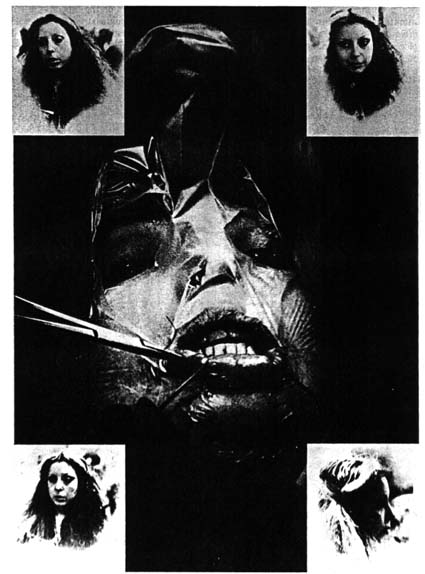
Like many artists of her generation both in France and in the U.S., Orlan was influenced by Duchamp. Her response was an extreme one: to consider her own body a "readymade." For more than a decade she has organized performances during which she undergoes plastic surgeries changing her face. Some of them are transmitted live to many places around the world. During the performance the artist talks to the audience, answers the questions, music is played and poetry read.

In 1990, Orlan shed her saintly robes and decided to be "reincarnated" by altering her face and body through a series of carefully planned and documented operations. The idea of turning surgical interventions into performance art occurred to her when she was operated on for an extra- uterine pregnancy under a local anesthetic which permitted her to play the role of detached observer as well as patient.

"I can observe my own body cut open, without suf

fering!... I see myself all the way down to my entrails; a new mirror stage. "I can see to the heart of my lover; his splendid design has nothing to do with sickly sentimentalities"- Darling, I love your spleen; I love your liver; I adore your pancreas, and the line of your femur excites me." (Orlan from Carnal Art Manifesto)

In the course The Reincarnation of Saint Orlan, the artist started to resemble some of the most well known paintings and sculptures including Mona Lisa. With self- transformation in mind, and proceeding with a cold, Cartesian logic buttressed by her considerable knowledge of esthetics and art history, Orlan began to deconstruct mythological images of women. Recalling that the ancient Greek artist Zeuxis made a practice of choosing the best parts from different models and combining them to produce the ideal woman, Orlan selected features -fetishized body parts- from famous Renaissance and post- Renaissance representations of idealized feminine beauty.

Orlan acknowledges a specific debt to Herman

Nitsch and the Viennese "Aktionismus" group that developed in the '60s--artists who startled spectators with their ritualistic staged imitations of blood sacrifices. Of all the Viennese artists, she is perhaps closest to Rudolf Schwarzkogler, who had himself photographed (supposedly) slicing off pieces of his penis as if it were so much salami.

However, there is a crucial difference between the Viennese actions and Orlan's peformances: with them as with many examples of Body art, there was an element of theatrical fakery. The barnyard and the abattoir, not the operating room, provided blood for the Viennese performance artists. "Documentary" photographs were frequently staged: Schwarzkogler did not bleed to death any more than Schwarzenegger's on-screen blood is real. (Nor did Yves Klein jump out a window.)

She aims to exorcise society's program to deprive women of aggressive instincts of any kind. During the process of planning, enacting and documenting the surgical steps of her transformation, Orlan remains in control of her own destiny. Orlan the artist and the woman will never play the victim: she is both subject and object, actress and director, passive patient and active organizer.

The new image after the plastic surgery is to be seen. However, Orlan radically changes this and shows what is to be hidden. The blood, tissues... all the materiality of human body. This way she refutes the devinely, perfect image attributed to women.

For more information on Orlan:

Orlan: Is this art? by Barbara Rose
Orlan's web site

Friday, December 01, 2006

Marina Abramovic - A Yugoslavian performance artist.

Biography that is a blend of realism and the imaginary to retell the life of a Yugoslav performer, Marina Abramovic. With rituals, based on the use of her own body, she explores the bounds of her physical and psychological resistance. This is not, however, mere reproduction of Abramovic's presentations, but rather of building a new reality: the performances are translated into cinema images and built into the fictional context of the film. Marina Abramovic plays herself, and assumes different forms that repeatedly distort or obscure her real identity. Memories blend with fantasy, dreams, artistic rituals, and day-to-day life - as if she were trying to look both ways at the same time, like a head with two faces, one turned towards the past and the other towards the future. This is an endeavor to discover herself and also to lend form to the creative process, with a narrative that frees itself from chronology and follows along with only image and sound. (source ubuweb)


EXPANSION IN SPACE


RELATION IN TIME

Monday, October 02, 2006

The Class on Sept. 26: Krzysztof Wodiczko, Ann Hamilton, Cai Guo-Qiang


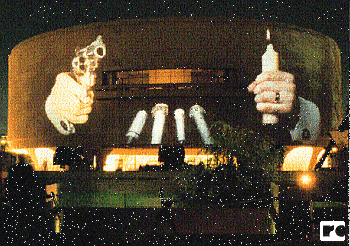
Wodiczko is internationally renowned for his large-scale slide and video projections on architectural facades and monuments. Since the late eighties, he has developed a series of nomadic instruments for both homeless and immigrant operators that function as implements for survival, communication, empowerment, and healing. He creates art by projecting images upon the monumental architecture found in large cities. The image of a homeless person materializes on a Boston war monument. The message of his medium adds to/edits that of the monument.
The artist spent half his life behind "the Iron Curtain" and the other half in Canada and the United States, so he has a well developed critique of power and it's abuses. Wodiczko's art is profoundly democratic. It forces the viewer to reexamine the function of architecture and to reconsider the political nature of the steel and concrete caverns of commerce that make up large cities.

For more information please click here!


Hamilton
was born in 1956 in Lima, Ohio. She trained in textile design at the University of Kansas, and later received an MFA from Yale University. While her degree is in sculpture, textiles and fabric have continued to be an important part of her work, which includes installations, photographs, videos, performances, and objects. She also questions the space around the art piece and ends up using the whole space. She is an important name of installation art.

For more information please click here!


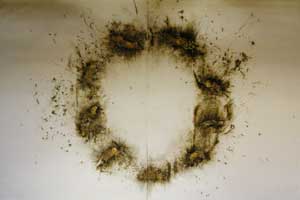
Cai Guo-Qiang was born in 1957 in Quanzhou City, Fujian Province, China, and lives and works in New York. He studied stage design at the Shanghai Drama Institute from 1981 to 1985 and attended the Institute for Contemporary Art: The National and International Studio Program at P.S. 1, New York. His work is both scholarly and politically charged.
He combines installation and traditional forms of Chinese art. His most prominent element od his body of work is called "gun powder drawings". He draws a comparison between drawing and love making; thus puts the emphasis on performance rather than the final image.
He says: "Art is not about what it is saying."

For more information please click here!