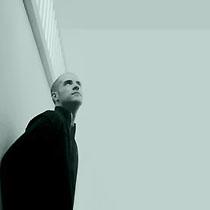
 Digital minimal composer, sound installation artist and graphic designer Richard Chartier has made a career of exploring the relationships between the spatial nature of sound, silence, focus, and the act of listening. As an artist, Chartier has been responsible for critically acclaimed releases on 12k/LINE (USA), Trente Oiseaux (Germany), Spekk (Japan), Mutek_rec (Canada), and Fallt (Ireland), including collaborations with artists Taylor Deupree, William Basinski, COH and *0, and has appeared on numerous international compilations.
Jumping into the scene in 1998 with the lauded debut "direct.incidental.consequential," Chartier followed with a series of releases culminating in the release of "Series," the premiere release on his LINE label that was awarded digital music honorable mention by the prestigious Prix Ars Electronica in 2001. Since then, he has released a string of acclaimed solo releases and collaborative works. He’s performed his works internationally at MUTEK (Montreal, Canada), GRM/Maison de Radio France (Paris, France), Observatori (Valencia, Spain), DEAF (Dublin, Ireland), Transmediale (Berlin, Germany), Lovebytes (Sheffield, UK), The Leeds International Film Festival (Leeds, UK), The Rotterdam International Film Festival (Netherlands), Garage (Stralsund, Germany), La Batie (Geneva, switzerland), and other noted digital art/music festivals and at exhibits such as Frequenzen [Hz] at the Schirn Kunsthalle (Frankfurt) and "A Minimal Future? Art as Object 1958-1968" and "Visual Music: Syneasthesia in Art and Music Since 1900" at the Museum of Contemporary Art (Los Angeles).
His music is near-silent. He comments on his own art on his website --> http://www.3particles.com
A significant element of my work over the past several years has been the use of digitally rendered sounds that necessitate a focused engagement on the part of the auditor. Soft and hushed--almost imperceptible--fragments, high frequencies, bursts, static and quiet, low, shifting tones create a complex textural field. Idealized as an asymtotic process of composition which approaches an unattainable paradigm of formalism, the evidence left of the work's creation speaks to an incremental and meticulous process of reduction. Sonic moments placed under a microscope for consideration and eventual emaciation; a cutting away or a deepening within and into an isolated microsecond. Compositional focus often occurs in the space between the sounds....
IN PERFORMANCE
My live performance differs perhaps most significantly from my recorded work by virtue of an increased audibility and activity. The sounds used are selected from a collection of predesigned sounds, culled from past compositions and unreleased work but chosen with attention to the space and situation in which they will be presented as part of a new performative composition.......
My live performance differs perhaps most significantly from my recorded work by virtue of an increased audibility and activity. The sounds used are selected from a collection of predesigned sounds, culled from past compositions and unreleased work but chosen with attention to the space and situation in which they will be presented as part of a new performative composition.......
(I cut them short, there are the remaining parts in his website)
In one of his interview he told his inspirations:
i have noticed that the things that influence my sound compositions the most have been visual. i think of sound in visual terms which stems from my education as a painter/designer. (and vice versa.. i often describe visual works with sound terms)
harry bertoia has interested me for a long time... his monoprints, his sound sculptures, his recordings, his design. i have collected mid century furniture since 1990 so thats where his work first entered my life.
marcel duchamp... because of the complete interrelationship between his works and his life, and the different mediums he explored.
other visual artists: gyorgy kepes, william baziotes, agnes martin, donald judd... off the top of my head.
harry bertoia has interested me for a long time... his monoprints, his sound sculptures, his recordings, his design. i have collected mid century furniture since 1990 so thats where his work first entered my life.
marcel duchamp... because of the complete interrelationship between his works and his life, and the different mediums he explored.
other visual artists: gyorgy kepes, william baziotes, agnes martin, donald judd... off the top of my head.
For one of his installations with Taylor Deupree click ----> http://www.gfineartdc.com/chartier/chartier.htm
-a comment on his art by Bret McCabe ---> http://www.citypaper.com/special/story.asp?id=5997
and I Promise it will be my last link,
/(^_^)\
downloadable clickie---->