art as an idea....
http://intermediaclass.blogspot.com/2006/10/conceptual-art-marcel-duchamp-and-sol.html
Showing posts with label conceptual art. Show all posts
Showing posts with label conceptual art. Show all posts
Monday, July 02, 2007

Tuesday, October 10, 2006
Conceptual Art, Marcel Duchamp and Sol Lewitt
Conceptual art, is art in which the concept(s) or idea(s) involved in the work take precedence over traditional aesthetic and material concerns. All of the planning and decisions are made beforehand and the execusion is a perfunctory affair. In some cases, Conceptual art may not entail any art object per se, but instead manifest solely as documentary evidence for an "art idea". In other, less extreme cases, Conceptual art may involve the construction of images and objects in a manner that frees the artist from their traditional role as a maker of aesthetic decisions.
Many of the works of the artist Sol Lewitt may be constructed by anyone simply by following a set of written instructions. This method was fundamental to Lewitt's definition of Conceptual art, the first to appear in print "Paragraphs on Conceptual Art", Art Forum, 1967.
The movement began in the early 20th century, but was based on the European Dada movement, its father Marcel Duchamp, and the writings of philosopher Ludwig Wittgenstein.

The French artist Marcel Duchamp paved the way for the conceptualists, providing them with examples of prototypically conceptual works (the readymades, for instance) that defied conventional categorisation. The most famous of Duchamp's readymades was Fountain (1917), a standard urinal basin signed by the artist with the pseudonym "R.Mutt", and submitted for inclusion in the annual, un-juried exhibition of the Society of Independent Artists in New York--it was rejected. In traditional terms, a commonplace object such as a urinal cannot be said to be art because it is not made by an artist or with any intention of being art, it is not unique, and it possesses few of the expected visual properties of the traditional, hand-crafted art object. Duchamp's relevance and theoretical importance for future "conceptualists" was later acknowledged by US artist Joseph Kosuth in his 1969 essay, "Art after Philosophy," when he wrote: "All art (after Duchamp) is conceptual (in nature) because art only exists conceptually."
(For more information: Making sense of Marcel Duchamp and Marcel Duchamp World Community )
Conceptual art was the forerunner for installation, digital, and performance art, more generally art that can be experienced.

Sol LeWitt (born 1928 in Hartford, Connecticut) is an artist linked to various movements including conceptual art and minimalism. His mediums are predominantly painting, drawing, and structures (a term he prefers in opposition to sculpture).
LeWitt's most characteristic sculpture works are based on connected open cubes and have titles like "Modular Wall Structure" and "Double Modular Cube." Because he works with modules and systems, and his early wall drawings are based on grids, he is sometimes described as a Minimal artist, but his work, especially his recent work, is usually colorful and often quite complex. It is also optimistic and beautiful.
In his writings "Sentences on Conceptual Art" and "Paragraphs on Conceptual Art" he puts down the characteristics of conceptual art. He distinguishes the new art form from the formal art by claiming that the former is mystical while the latter is rational. He says that irrational thoughts should be followed absolutely and logically. For him banal ideas cannot be rescued by beautiful execution, on the contrary his understanding of the process is machine-like. Also, he makes a distinction between conceptional and perceptional art. Perceptional art is for the sensation of the eye, like optical, kinetic, light and color art.
The rules Lewitt manifested in his writings contradict with the works of Turrell and Orozco. Turrell uses light predominantly, and the way his works actually seen is important, on the other hand, his ideas behind his body of work do matter a lot as well. Should he be considered as a perceptional or conceptional artist?
Orozco, on the other hand found the art making process very important, as opposed to Lewitt.
Can we ever reach a consensus about what distinguishes conceptual art; or what is art and what is not at the first place? The fountain was a joke for Duchamp, but was taken very seriously by critics. Can we produce art by solely placing objects in the museum, by altering their message? How much does the final look of the work matter; and how about the concept of it?
What should be our criteria?
Many of the works of the artist Sol Lewitt may be constructed by anyone simply by following a set of written instructions. This method was fundamental to Lewitt's definition of Conceptual art, the first to appear in print "Paragraphs on Conceptual Art", Art Forum, 1967.
The movement began in the early 20th century, but was based on the European Dada movement, its father Marcel Duchamp, and the writings of philosopher Ludwig Wittgenstein.
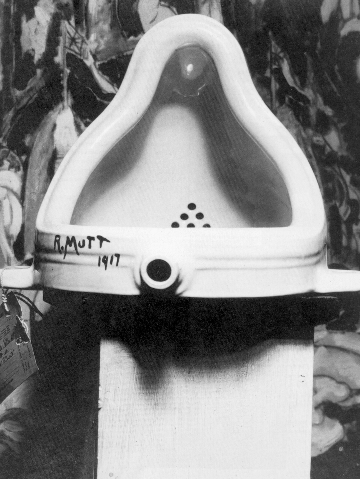
The French artist Marcel Duchamp paved the way for the conceptualists, providing them with examples of prototypically conceptual works (the readymades, for instance) that defied conventional categorisation. The most famous of Duchamp's readymades was Fountain (1917), a standard urinal basin signed by the artist with the pseudonym "R.Mutt", and submitted for inclusion in the annual, un-juried exhibition of the Society of Independent Artists in New York--it was rejected. In traditional terms, a commonplace object such as a urinal cannot be said to be art because it is not made by an artist or with any intention of being art, it is not unique, and it possesses few of the expected visual properties of the traditional, hand-crafted art object. Duchamp's relevance and theoretical importance for future "conceptualists" was later acknowledged by US artist Joseph Kosuth in his 1969 essay, "Art after Philosophy," when he wrote: "All art (after Duchamp) is conceptual (in nature) because art only exists conceptually."
(For more information: Making sense of Marcel Duchamp and Marcel Duchamp World Community )
Conceptual art was the forerunner for installation, digital, and performance art, more generally art that can be experienced.

Sol LeWitt (born 1928 in Hartford, Connecticut) is an artist linked to various movements including conceptual art and minimalism. His mediums are predominantly painting, drawing, and structures (a term he prefers in opposition to sculpture).
LeWitt's most characteristic sculpture works are based on connected open cubes and have titles like "Modular Wall Structure" and "Double Modular Cube." Because he works with modules and systems, and his early wall drawings are based on grids, he is sometimes described as a Minimal artist, but his work, especially his recent work, is usually colorful and often quite complex. It is also optimistic and beautiful.
In his writings "Sentences on Conceptual Art" and "Paragraphs on Conceptual Art" he puts down the characteristics of conceptual art. He distinguishes the new art form from the formal art by claiming that the former is mystical while the latter is rational. He says that irrational thoughts should be followed absolutely and logically. For him banal ideas cannot be rescued by beautiful execution, on the contrary his understanding of the process is machine-like. Also, he makes a distinction between conceptional and perceptional art. Perceptional art is for the sensation of the eye, like optical, kinetic, light and color art.
The rules Lewitt manifested in his writings contradict with the works of Turrell and Orozco. Turrell uses light predominantly, and the way his works actually seen is important, on the other hand, his ideas behind his body of work do matter a lot as well. Should he be considered as a perceptional or conceptional artist?
Orozco, on the other hand found the art making process very important, as opposed to Lewitt.
Can we ever reach a consensus about what distinguishes conceptual art; or what is art and what is not at the first place? The fountain was a joke for Duchamp, but was taken very seriously by critics. Can we produce art by solely placing objects in the museum, by altering their message? How much does the final look of the work matter; and how about the concept of it?
What should be our criteria?
Subscribe to:
Posts (Atom)