Showing posts with label video. Show all posts

Tuesday, July 10, 2007

Maya Deren and Experimental Work in Video

"And what more could I possibly ask as an artist than that your most precious visions, however rare, assume sometimes the forms of my images.


Deren was a dancer, choreographer, poet, writer and photographer. In the cinema she was a director, writer, cinematographer, editor, performer, entrepreneur and pioneer in experimental filmmaking in the United States.


When she was born in Kiev in 1917 and was named Eleanora. In 1922 the Derenkowsky family fled to New York due to the threat of anti-semitism in the Ukraine. They contracted and Anglicized their name to Deren.


As a young woman Eleanora Deren studied journalism and political science and became active in student politics at Syracuse University. Deren transferred to New York University where she was awarded her undergraduate degree in 1936. At Smith College she completed a Masters Degree in English Literature and symbolist poetry in 1939. After college Deren began working as an assistant to the famous dancer and choreographer, Katherine Dunham. Deren found inspiration and nomadic adventure with the innovative Katherine Dunham Dance Company, touring and performing across the US. It was in Los Angeles in 1941 that Deren met Alexander Hammid, a Czechoslovakian filmmaker working in Hollywood. In collaboration with Hammid, Deren produced her first and most remarkable experimental film Meshes of the Afternoon (1943).


In 1943 she changed her name to Maya and shifted her focus from dance to film.

Rhythm is a defining element of all of Deren's films, it arises from the play of repetition and variation which is integral to her experiments in narrative. Meshes deploys an innovative style of cutting on action where the protagonist steps over such disparate terrains as the beach, soil, grass and concrete. The rhythmic drumbeat and the repeated movement highlight her deliberate progress across these discontinuous spaces. As the central, consistent element, Its soundtrack enables Deren's temporal and spatial experimentation."

from the article by Wendy Haslem:
Maya Deren: The High Priestess of Experimental Cinema
http://www.sensesofcinema.com/contents/directors/02/deren.html

for more information on the woman "who makes the world dance":
http://www.cosmicbaseball.com/deren9.html#text

"Some Metaphors For The Creative Process" by Maya Deren
http://www.wam.umd.edu/%7Emolouns/amst450/village/deren.html


Thursday, February 01, 2007

Vincent Price

It's been a long time since I wanted to share this video with you.
Vincent Price is one of my favorites.


Vincent Tim Burton - Court métrage

Wednesday, December 27, 2006

Heart Made of Sound/ a stop motion video


Heart Made of Sound
Video sent by Cay

The Softlightes - Heart Made of Sound

A nice stop motion short movie by Kris Moye

i am realizing that there is a stop motion society growing between intermediatics. so i hope you will enjoy this video guys./ stop motion gücü adına!

Thursday, December 21, 2006

Entr'acte

"An absolute dada movie. Somebody gets killed, his coffin gets out of control and after a chase it stops. The person gets out of it and let everybody who followed the coffin dissapear." A must see avant-garde film. Directed by René Clair in 1924, you can see the modernists Francis Picabia, Marcel Duchamp, Man Ray, Erik Satie, Darius Milhaud and others in the film.

Friday, December 01, 2006

Marina Abramovic - A Yugoslavian performance artist.

Biography that is a blend of realism and the imaginary to retell the life of a Yugoslav performer, Marina Abramovic. With rituals, based on the use of her own body, she explores the bounds of her physical and psychological resistance. This is not, however, mere reproduction of Abramovic's presentations, but rather of building a new reality: the performances are translated into cinema images and built into the fictional context of the film. Marina Abramovic plays herself, and assumes different forms that repeatedly distort or obscure her real identity. Memories blend with fantasy, dreams, artistic rituals, and day-to-day life - as if she were trying to look both ways at the same time, like a head with two faces, one turned towards the past and the other towards the future. This is an endeavor to discover herself and also to lend form to the creative process, with a narrative that frees itself from chronology and follows along with only image and sound. (source ubuweb)


EXPANSION IN SPACE


RELATION IN TIME

Wednesday, November 08, 2006

Class on Nov. 7: Intermedia Painting


Stan Brakhage (1933 - 2003) is regarded as one of the most important American filmmakers of the 20th century.

Brakhage was born as Robert Sanders in an orphanage in Kansas City, Missouri. Three weeks after his birth, he was adopted by Ludwig and Clara Brakhage, and he was given the name James Stanley Brakhage.

As a child, he appeared on radio as a boy soprano before going to high school and then dropping out of Dartmouth College after several months to make films. He was influenced by the writings of Sergei Eisenstein and the films of Jean Cocteau as well as the Italian neorealism movement.

In 1953, Brakhage moved to San Francisco where he associated with poets such as Robert Duncan and Kenneth Rexroth. In late 1954, he moved to New York City where he associated with a number of contemporary artists, such as abstract expressionist painters and beat generation poets, among them Maya Deren, Marie Menken, Joseph Cornell and John Cage.

In a time, 1950s, when film id rooted in Hollywood cinema and large productions Stanley Brakhage made his films by himself and one camera. Brakhage's films are usually silent and lack a traditional story, being more analogous to visual poetry than to prose story-telling. He often referred to them as "visual music." His films range in length from just a few seconds to several hours, but most last between two or three minutes and one hour. For him the film itself was also a material. Most of his work was done in 8 mm or 16 mm film, and he frequently hand-painted the film or scratched the image directly into the film emulsion, baked the film in the owen and sometimes used collage techniques. For Monthlight(1963), for example, he stuck moth wings, twigs, and leaves onto tape and made prints from it. He called his style as "closed eye vision" in which painting and cinema work in a totally different way.

Brakhage's work covers a variety of subjects and techniques. Window Water Baby Moving (1959) is a record of the birth of his first child, while 23rd Psalm Branch (1966-67) is a meditation on war that intercuts footage of Colorado, where he lived, with shots of World War II. Dog Star Man (1961-64), perhaps his most famous work, features a man climbing a mountain, shots of stellar objects and more footage of his wife giving birth. It is usually read as addressing the unity of creation. Works from his later periods include the four-part "Faust Series" (1987-89), the four-part "Visions in Meditation" (1989-90), "Passage Through: A Ritual" (1991), and "The Vancouver Island Quartet" (1991-2002). He also completed several more collaborations with musicians, including two more works with music by James Tenney, "Christ Mass Sex Dance" (1991), and "Ellipses #5" (1998). For Marilyn, which was made in 1992 was about his wife and her embodying his concept of God.

Brakhage wrote a number of books, including Metaphors on Vision (1963) and the posthumously published "Telling Time: Essays of a Visionary Filmmaker" (2003). He often gave lectures at universities, museums, galleries, film festivals and so on.
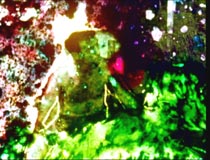
It is believed that the coal-tar dyes he used to paint his films contributed to the cancer.

His work has had some small impact on contemporary art, music videos, mainstream cinema. The credits of the film Seven, with their scratched emulsion, rapid cutaways and bursts of light are very much in Brakhage's style.

Stanley Brakhage: a short information by Fred Camper


Barry McGee
A lauded and much-respected cult figure in a bi-coastal subculture that comprises skaters, graffiti artists, and West Coast surfers, Barry McGee was born in 1966 in California, where he continues to live and work. In 1991 he receiv ed a BFA in painting and printmaking from the San Francisco Art Institute. His drawings, paintings, and mixed-media installations take their inspiration from contemporary urban culture, incorporating elements such as empty liquor bottles and spray-paint cans, tagged signs, wrenches, and scrap wood or metal. McGee is also a graffiti artist, working on the streets of America’s cities since the 1980s, where he is known by the tag name “Twist.” He views graffiti as a vital method of communication, one that keeps him in touch with a larger, more diverse audience than can be reached through the traditional spaces of a gallery or museum. His trademark icon, a caricatured male figure with sagging eyes and a bemused expression, recalls the homeless people and transients who call the streets their home. “Compelling art to me is a name carved into a tree,” says McGee. His work has been shown at the Walker Art Center in Minneapolis, the San Francisco Museum of Modern Art, the UCLA/Armand Hammer Museum in Los Angeles, and on streets and trains all over the United States. He and his daughter, Asha, live in San Francisco.


Matthew Ritchie was born in London, England in 1964, and lives and works in New York. He received a BFA from Camberwell School of Art, London, and attended Boston University. His artistic mission has been no less ambitious than an attempt to represent the entire universe and the structures of knowledge and belief that we use to understand and visualize it. Ritchie’s encyclopedic project (continually expanding and evolving like the universe itself) stems from his imagination, and is catalogued in a conceptual chart replete with allusions drawn from Judaeo-Christian religion, occult pract
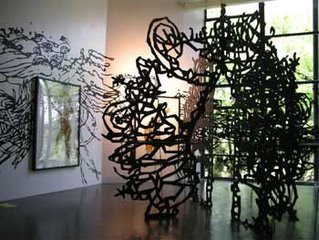
ices, Gnostic traditions, and scientific elements and principles. Ritchie’s paintings, installations, and narrative threads delineate the universe’s formation as well as the attempts and limits of human consciousness to comprehend its vastness. Ritchie’s work deals explicitly with the idea of information being ‘on the surface’, and information is also the subject of his work. Although often described as a painter, Ritchie creates works on paper, prints, light-box drawings, floor-to-wall installations, freestanding sculpture, web sites, and short stories which tie his sprawling works together into a narrative structure. Drawing is central to his work, he doesn't think that there are boundries between drawing, sculpture and computer games, though. He perceives it as information. He scans his drawings into the computer so that images can be blown up, taken apart, made smaller or three-dimensional, re-shaped, transformed into digital games, or given to someone else to execute. One ongoing work that Ritchie calls an endless drawing contains everything he has drawn before. Ritchie’s work has been shown in one-person exhibitions at the Dallas Museum of Art; Contemporary Arts Museum, Houston; MASS MoCA; SFMoMA; and the Museum of Contemporary Art, Miami, among others. His work was also exhibited at the Whitney Biennial (1997), Sydney Biennale (2002), and São Paulo Bienale (2004).


An interview by Owen Drolet

Wednesday, October 25, 2006

once an intermediatic, always an intermediatic!

First intermedia event. Video by Ali İhsan Uğurlu.

Saturday, October 21, 2006

Class on Oct. 17: experimental works in video

Jan Svankmayer

Czechoslovak animator extraordinaire, Jan has been making intensely bizarre films since the mid-'60s. Most of his work is a mix between 3-D stop-motion animation, puppets and live-action, but it can involve any mix of the above. His stories are eerie, delightful, dreamlike and surreal. His actors include real people, machines, socks, clay figures, antique dolls, pencil sharpeners, and skeletons or stuffed corpses of animals, among other things. His sets are usually decaying Czech buildings or landscapes, decorated with waste of the industrial age: rotting furniture, rusty nails, sawdust, oily screws, and the like.

for A Jan Svankmayer filmography/videography page, please click here!

Svankmayer definetely influenced many others like Tim Burton. Brothers Quay took his ideas much further and even dedicated "The Cabinet of Jan Svankmayer" to him.


Brothers Quay

Identical twins born in Norristown, Pennsylvania, Stephen and Timothy Quay studied at the Philadelphia College of Art until they transferred to London's Royal College of Art, where they started producing animated shorts in the early 70s.

The Quay's films are influenced by those of Jan Svankmajer: a harsh, grimy world where decay is the primary decor, but they add a sharp neo-gothic edge to and maintain a thoroughly personal hand-on approach to their film-making, where Svankmajer designs his films and lets others animate them. Not only their materails and political ideas are striking, but also their editing techniques: the rythym created by the movement of the camera. The Quay's puppets are also of the same ilk (creepy antiquated-looking toys, bones, meat, etc.), but have a more polished look. The Quay's plots are minimal and dark, their films surreal, stream-of-consciousness nightmares with a definite edge of humor.

Some of the Quay's actual sets and puppets are on permanent exhibition at The Museum of the Moving Image in London.

Since they don't want their images on web, we cannot include any. Yet, for the filmography you can click here.


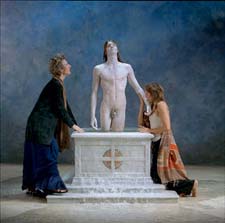
Bill Viola
Born in January 25, 1951, he is today known for his work in video art. His exhibition profile, which includes the Guggenheim Berlin, Guggenheim New York, Getty Los Angeles, California, and the Metropolitan Museum of Art, New York marks him as a major artist, at least by standards of public fame and repute. His work has also received extensive critical praise from both within the video art community and in the culture at large, which is unusual for an artist whose work often challenges the narrative conventions of the television screen.

His early work established his fascination with issues that continue to inform his work today. In particular, Viola's obession with capturing the essence of emotion through recording of its extreme display began at least as early as his 1976 work, "The Space Between the Teeth", a video of himself screaming, and continues to this day with such works as the 45-second "Silent Mountain" (2001), which shows two actors in states of anguish.

If Viola's depictions of emotional states with no objective correlative -- emotional states for which the viewer has no external object or event to understand them by -- are one striking feature of many of his works, another, which has come to the forefront, is his reference to medieval and classical depictions of emotion. Most immediately, his subdued "Catherine's Room" 2001, has many scene by scene parallels with Andrea di Bartolo's 1393 "St. Catherine of Siena Praying".

While many video artists have been quick to adopt new technologies to their medium, Viola relies little, if at all, on computer editing and modification of his video. Perhaps the most technically challenging part of his work -- and that which has benefitted most from the advances since his earliest pieces -- is his use of extreme slow motion. "The Quintet Series" 2000 is one such piece (actually a set of four separate videos), that shows the unfolding expressions of the five actors in such slow motion that the expressions become almost unrecognizable. The series is a challenging one for the viewer, because the concentration required to follow the facial expressions over time must last for minutes or more. In general, the distortion of time, along with the lack of sound or voice over, form the most immediately ""new"" aspects of Viola's work for the first-time viewer.

One remarkable piece by Viola is his "Observance" 2002, which may be taken partly as a response to the September 11, 2001 Terrorist Attacks. "Observance" places the camera at eye level facing the head of a line of people of a wide variety of ages. As "Observance" unfolds, the line slowly advances, with each person pausing at the front of the line in a state of intense -- though quiet -- grief, before ceding their place to the next person in line.

In 2004, Viola embarked on "The Tristan Project". At the invitation of opera director Peter Sellars, he created video sequences to be shown as a backdrop to the action on stage during the performance (directed by Sellars) of Wagner's opera Tristan und Isolde. Using his trademark extreme slow motion, Viola's pieces used actors to portray the metaphorical story behind Wagner's story, seeing for example the first act as an extended ritual of purification in which the characters disrobe and wash themselves before finally plunging headlong into water together (in Wagner's story, the two characters maintain the facade of being indifferent to each other (necessary because Isolde is betrothed to Tristan's uncle) before, mistakenly believing they are going to die anyway, they reveal their true feelings). Viola trademarks such as fire and water are much in evidence here. The piece was first performed in Los Angeles at Disney Hall on 3 separate evenings in 2004, one act at a time, then given complete performances at the Bastille Opera in Paris in April and November 2005. The video pieces were later shown in London without Wagner's music in June to September 2006, at the Haunch of Venison Gallery and St Olave's College.

Viola's work has received many critical accolades. Marjorie Perloff, best known for her poetry criticism and her promotion of avant-garde writers and styles, singles him out for praise. Perloff, who has written at length about the necessity of poetic works responding to and taking advantage of contemporary computer technologies, has written of Viola as an example of how new technology -- in his case, the video camera -- can create entirely new aesthetic criteria and possibilities that did not exist in previous incarnations of the genre -- in this case, theater.


For Bill Viola's official web site, please click here!

Monday, October 02, 2006

The Class on Sept. 26: Krzysztof Wodiczko, Ann Hamilton, Cai Guo-Qiang


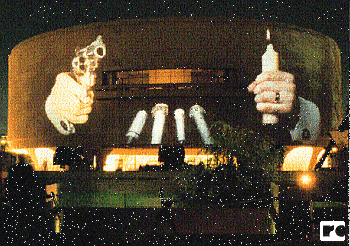
Wodiczko is internationally renowned for his large-scale slide and video projections on architectural facades and monuments. Since the late eighties, he has developed a series of nomadic instruments for both homeless and immigrant operators that function as implements for survival, communication, empowerment, and healing. He creates art by projecting images upon the monumental architecture found in large cities. The image of a homeless person materializes on a Boston war monument. The message of his medium adds to/edits that of the monument.
The artist spent half his life behind "the Iron Curtain" and the other half in Canada and the United States, so he has a well developed critique of power and it's abuses. Wodiczko's art is profoundly democratic. It forces the viewer to reexamine the function of architecture and to reconsider the political nature of the steel and concrete caverns of commerce that make up large cities.

For more information please click here!


Hamilton
was born in 1956 in Lima, Ohio. She trained in textile design at the University of Kansas, and later received an MFA from Yale University. While her degree is in sculpture, textiles and fabric have continued to be an important part of her work, which includes installations, photographs, videos, performances, and objects. She also questions the space around the art piece and ends up using the whole space. She is an important name of installation art.

For more information please click here!


Cai Guo-Qiang was born in 1957 in Quanzhou City, Fujian Province, China, and lives and works in New York. He studied stage design at the Shanghai Drama Institute from 1981 to 1985 and attended the Institute for Contemporary Art: The National and International Studio Program at P.S. 1, New York. His work is both scholarly and politically charged.
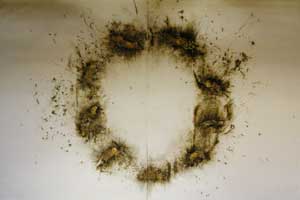
He combines installation and traditional forms of Chinese art. His most prominent element od his body of work is called "gun powder drawings". He draws a comparison between drawing and love making; thus puts the emphasis on performance rather than the final image.
He says: "Art is not about what it is saying."

For more information please click here!